
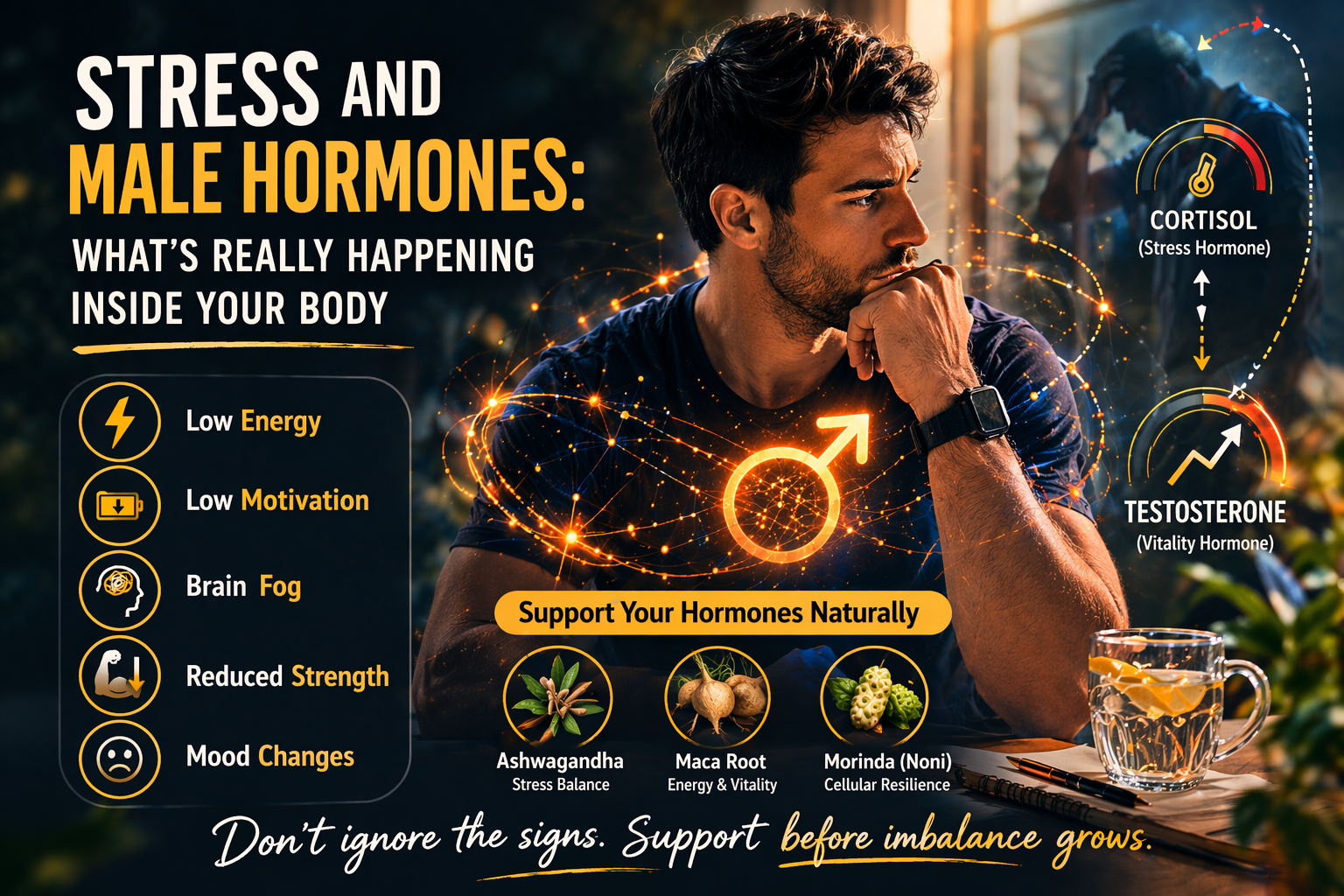
Stress and Testosterone — The Hidden Connection Most Men Miss
You think it’s just stress.
Work pressure.
Deadlines.
Responsibility.
Nothing unusual.
But lately…
You feel more tired than usual.
Less motivated.
Less driven.
And you don’t connect it to hormones.
But here’s the truth:
Stress and testosterone are deeply connected.
When Stress Becomes Your Daily Normal
It doesn’t feel extreme.
It feels like:
- You constantly thinking about work
- You rarely feeling fully relaxed
- You pushing through fatigue
- You sleeping—but not recovering
You’re functioning.
But not fully.
And over time, this “normal stress” starts affecting your body in ways you don’t notice.
What’s Actually Happening Inside Your Body
Let’s break it down simply:
Stress → Cortisol → Testosterone Suppression
- When you’re stressed, your body releases cortisol
- Cortisol prepares your body for survival, not recovery
- Over time, high cortisol interferes with testosterone production
This is the core cortisol and testosterone relationship.
And it explains why many men ask:
👉 “Does stress lower testosterone?”
Yes—especially when it becomes chronic.
In fact, long-term stress can suppress testosterone, reduce recovery, and impact overall vitality.
Signs Stress Is Affecting Your Testosterone
These don’t always feel obvious:
- Low energy despite rest
- Reduced motivation or drive
- Difficulty focusing
- Lower physical performance
- Mood changes or irritability
- Feeling mentally and physically drained
These are real stress effect on male hormones.
But they build slowly—so they’re easy to ignore.
Why Your Body Does This (And Why It’s Not Wrong)
Your body is designed to protect you.
When it senses constant stress:
- It shifts into survival mode
- It reduces non-essential functions
- Reproductive hormones (like testosterone) become secondary
This is not failure.
It’s adaptation.
Even modern lifestyle stress—work pressure, mental overload—can lead to hormonal imbalance and reduced vitality.
Understanding Herbal Support (Only What Matters Here)
Since stress is the root, support should start there.
🌿 Stress & Cortisol Regulation
- Ashwagandha → helps regulate cortisol and supports testosterone balance
This is one of the most directly relevant herbs for this topic.
⚡ Adaptation & Energy Recovery
- Maca Root → helps the body adapt to stress and supports energy
When stress drains you, recovery matters.
🧠 Nervous System Support
- Morinda (Noni) → supports cellular resilience and stress adaptation
Helps your system handle pressure better over time.
These herbs don’t force testosterone.
They support the environment where testosterone can function better.
A Perspective You Shouldn’t Ignore
Your body is not “losing testosterone randomly.”
It’s responding to:
- Constant pressure
- Lack of recovery
- Mental overload
And the solution is not pushing harder.
It’s supporting your system.
As a preventive approach suggests:
you don’t wait for a breakdown—you support early.
Supporting Stress and Testosterone Naturally
Keep it simple:
1. Reduce Daily Stress Load
Not everything needs urgency.
2. Improve Recovery
Sleep is not enough—quality matters.
3. Create Mental Off-Time
Your brain needs breaks to reset hormonal signals.
4. Support Gradually
Herbal and lifestyle support works best when consistent.
Small Steps That Make a Real Difference
Start here:
- Take 10 minutes daily with no stimulation
- Get sunlight early in the morning
- Avoid late-night screen exposure
- Don’t skip meals
- Reduce constant multitasking
- Listen to your energy instead of ignoring it
Small changes → big hormonal signals.
A Thought to Carry Forward
Stress is not just mental.
It’s hormonal.
And the longer it stays,
the deeper it affects your system.
But the good news?
You don’t need extreme solutions.
You need consistent support—before imbalance becomes a problem.
FAQ Section
— Always consult a healthcare provider before starting new supplements, especially if you have underlying conditions.