
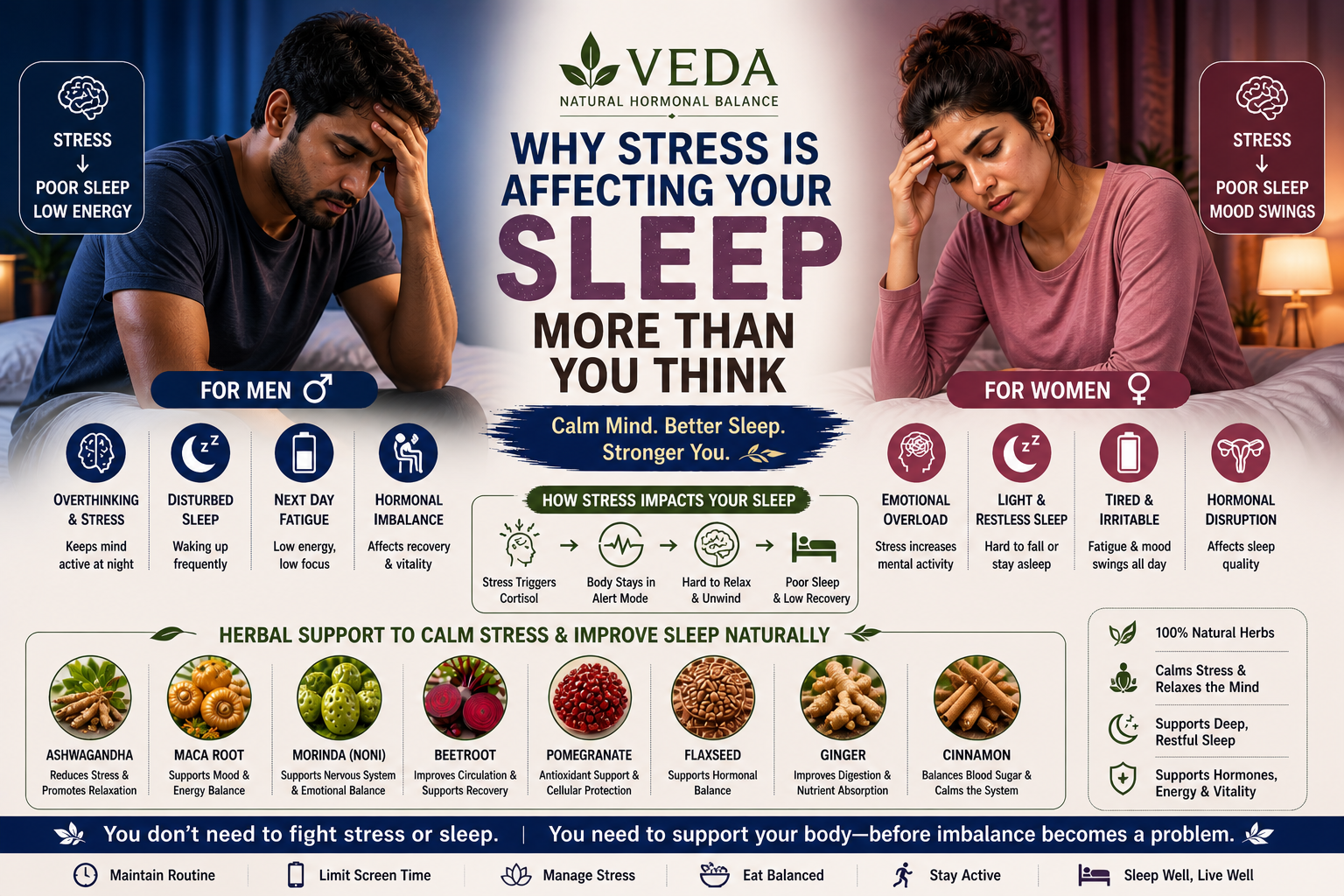
Stress and Sleep Problems — When You’re Tired but Can’t Sleep
You go to bed feeling tired.
Your body wants rest.
Your mind doesn’t.
You lie there…
thinking, replaying, overanalyzing.
And the question keeps coming:
“Why can’t I just fall asleep?”
If this feels familiar, you’re likely dealing with
stress and sleep problems.
When Your Body Is Tired but Your Mind Won’t Switch Off
It doesn’t look like “insomnia.”
It looks like:
- You taking too long to fall asleep
- You waking up in the middle of the night
- You feeling tired even after sleeping
- You thinking constantly before bed
This is what many experience as
poor sleep due to stress.
What’s Happening Inside Your Body (Simple Explanation)
Sleep is not just about lying down.
It’s about feeling safe enough to rest.
Here’s the simple chain:
Stress → Cortisol → Nervous System → Sleep Quality
- Stress increases cortisol (alertness hormone)
- Your body stays in “active mode”
- Your nervous system doesn’t fully relax
- Deep sleep becomes harder
This is why
stress affects sleep more than you think.
In fact, stress-linked sleep disturbance is one of the most common issues people face today, affecting both mental recovery and hormonal rhythm.
Signs Stress Is Affecting Your Sleep
You might notice:
- Difficulty falling asleep
- Waking up multiple times at night
- Light, non-refreshing sleep
- Feeling tired even after sleeping
- Racing thoughts at night
- Morning fatigue
These are early signs of
can stress cause insomnia — yes, it can.
The Deeper Truth Most People Miss
Your body is not refusing sleep.
It’s staying alert.
Because from its perspective:
- There is “something to handle”
- There is “pressure to respond to”
So instead of entering deep rest…
Your system stays semi-active.
That’s why sleep feels incomplete.
Understanding Herbal Support (Sleep & Stress Focus)
To improve sleep, you need to calm the system—not force sleep.
🌿 Stress & Nervous System Balance
- Ashwagandha → helps regulate cortisol and calm the system
- Morinda (Noni) → supports nervous system resilience
These help your body feel safe enough to rest.
🧠 Mental Calm & Emotional Balance
- Maca Root → supports emotional balance and stress adaptation
- Cocoa → supports mood and relaxation
Because mental calmness is key for sleep.
🧬 Hormonal & Internal Balance
- Flaxseed → supports hormone signaling
- Moringa → provides essential nutrients
Hormonal balance supports sleep rhythm.
❤️ Circulation & Recovery Support
- Beetroot & Pomegranate → support blood flow and cellular recovery
Better recovery = deeper sleep.
🔥 Absorption Support
- Ginger, Black Pepper, Cinnamon → improve nutrient absorption
Because your body needs to use what it receives.
A Perspective You Need to Shift
You don’t have a sleep problem.
You have a stress response problem.
Sleep is a result—not a task.
When your body feels calm and balanced,
sleep happens naturally.
Small Steps That Improve Sleep Naturally
Start simple:
- Avoid screens 30–60 minutes before bed
- Keep lights dim in the evening
- Maintain consistent sleep timing
- Avoid heavy thinking right before bed
- Take slow, deep breaths before sleeping
- Get sunlight during the day
These help your body reset its rhythm.
A Reassuring Truth
Your body knows how to sleep.
It hasn’t forgotten.
It just doesn’t feel relaxed enough yet.
And once you reduce internal pressure,
sleep returns naturally.
As a preventive approach suggests:
You don’t wait for insomnia—
you support your body early.
A Thought to Carry Forward
Sleep is not something you force.
It’s something your body allows.
And the moment your system feels safe and supported…
Rest begins.
Start supporting your body before it starts asking louder.
FAQ Section
— Always consult a healthcare provider before starting new supplements, especially if you have underlying conditions.