
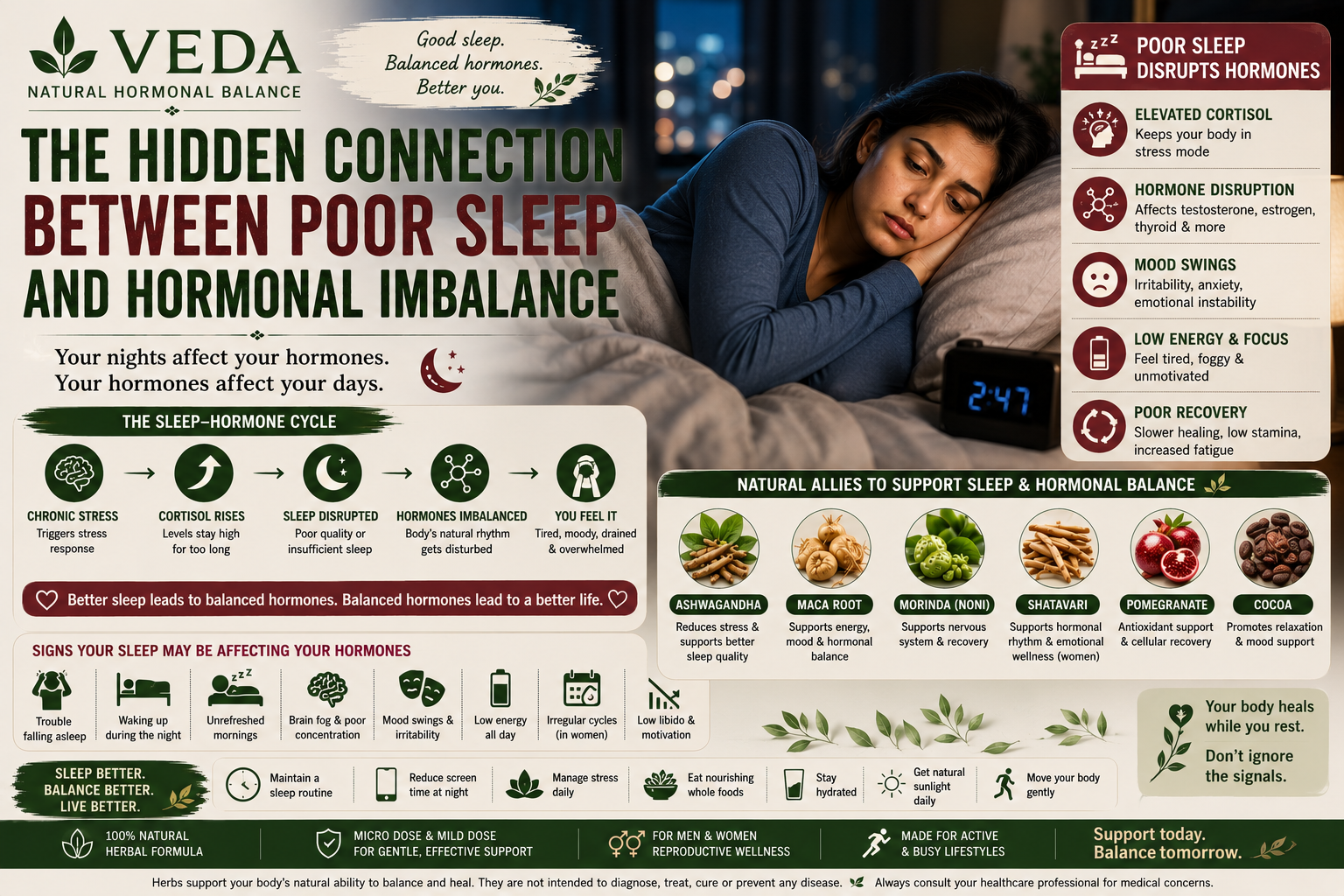
Why Does Poor Sleep Affect Everything?
You go to bed tired.
But your mind stays active.
You wake up multiple times.
Or you sleep for hours and still feel exhausted the next day.
Then slowly…
Your mood changes.
Your energy drops.
Your body feels “off” in ways you can’t fully explain.
This is where many people unknowingly enter the cycle of
sleep and hormonal imbalance.
And most don’t realize how deeply connected they really are.
When Poor Sleep Becomes Your New Normal
At first, it feels temporary.
A few late nights.
A stressful week.
A disrupted routine.
But over time, poor sleep starts affecting:
- Energy levels
- Mood stability
- Stress tolerance
- Motivation
- Hormonal rhythm
And eventually your body begins struggling to fully recover.
This is one reason behind many
hormone disruption symptoms.
What’s Happening Inside Your Body (Simple Explanation)
Sleep is when your body resets itself.
Hormones depend heavily on that recovery process.
Here’s the simple chain:
Stress → Cortisol → Poor Sleep → Hormonal Imbalance
- Stress increases cortisol
- High cortisol keeps the nervous system alert
- Deep recovery sleep becomes harder
- Hormonal rhythm becomes disrupted
This creates the
cortisol and sleep
connection many people experience without realizing it.
Stress-linked sleep disturbance is strongly associated with hormonal imbalance, fatigue, mood instability, and poor recovery.
Signs Poor Sleep May Be Affecting Your Hormones
You may notice:
- Feeling tired even after sleeping
- Mood swings or irritability
- Brain fog or low focus
- Low motivation
- Emotional exhaustion
- Increased stress sensitivity
- Irregular cycles or hormonal fluctuations
- Feeling “wired but tired”
These are common signals that your recovery system may be overloaded.
Why Sleep Is So Important for Hormonal Balance
Your body performs many important recovery processes during sleep.
This includes support for:
- Stress hormone regulation
- Testosterone and reproductive hormones
- Mood-related neurotransmitters
- Cellular repair and recovery
When sleep quality drops consistently, the body struggles to maintain internal balance.
That’s why
poor sleep hormones
are closely connected.
Poor sleep quality is commonly linked with hormonal rhythm disruption and reduced recovery capacity.
A Reassuring Truth You Need to Hear
Your body is not “lazy” or weak.
It may simply be overstimulated for too long.
Modern life keeps many people stuck in constant activation:
- Stress
- Screens
- Overthinking
- Late-night stimulation
- Emotional overload
Eventually, the nervous system struggles to fully relax.
And without proper recovery…
Hormones begin feeling the impact too.
Understanding Natural Support (Sleep + Hormonal Recovery)
The goal is not to “force sleep.”
It’s to help the body feel safe enough to recover naturally.
🌿 Stress & Sleep Support
- Ashwagandha → supports stress hormone balance and relaxation
- Morinda (Noni) → supports nervous system resilience
These herbs are commonly associated with stress-linked sleep support.
⚡ Recovery & Energy Support
- Maca Root → supports resilience, vitality, and hormonal balance
- Beetroot & Pomegranate → support circulation and cellular recovery
Because better recovery supports better energy.
🌸 Hormonal Rhythm Support
- Shatavari → supports female hormonal rhythm and emotional balance
- Flaxseed → supports hormone signaling and healthy fat balance
Hormonal rhythm and sleep rhythm influence each other constantly.
🧬 Nutritional & Nervous System Support
- Moringa → provides micronutrient nourishment
- Cocoa → supports emotional well-being and antioxidant balance
- Ginger & Cinnamon → support digestion and nutrient utilization
A nourished body recovers better.
Small Sleep Habits That Matter More Than You Think
You don’t need extreme sleep routines.
Start with simple consistency:
- Sleep and wake at similar times daily
- Reduce screens before bed
- Avoid overstimulation late at night
- Keep your room calm and dark
- Avoid excessive caffeine late in the day
- Allow yourself moments of mental quietness
Small habits help your nervous system feel safer.
A Perspective Worth Remembering
Sleep is not “wasted time.”
It’s one of the most important recovery systems your body has.
And many people don’t realize how much emotional balance, hormonal health, and energy depend on it.
Preventive wellness is about supporting recovery before deeper imbalance develops—not waiting until exhaustion becomes overwhelming.
A Thought to Carry Forward
Your body heals quietly.
Through rest.
Through rhythm.
Through recovery.
And sometimes…
The most productive thing you can do for your hormones is stop fighting exhaustion and start supporting sleep properly.
Support your body gently, consistently, and before imbalance grows louder.
FAQ Section
— Always consult a healthcare provider before starting new supplements, especially if you have underlying conditions.