
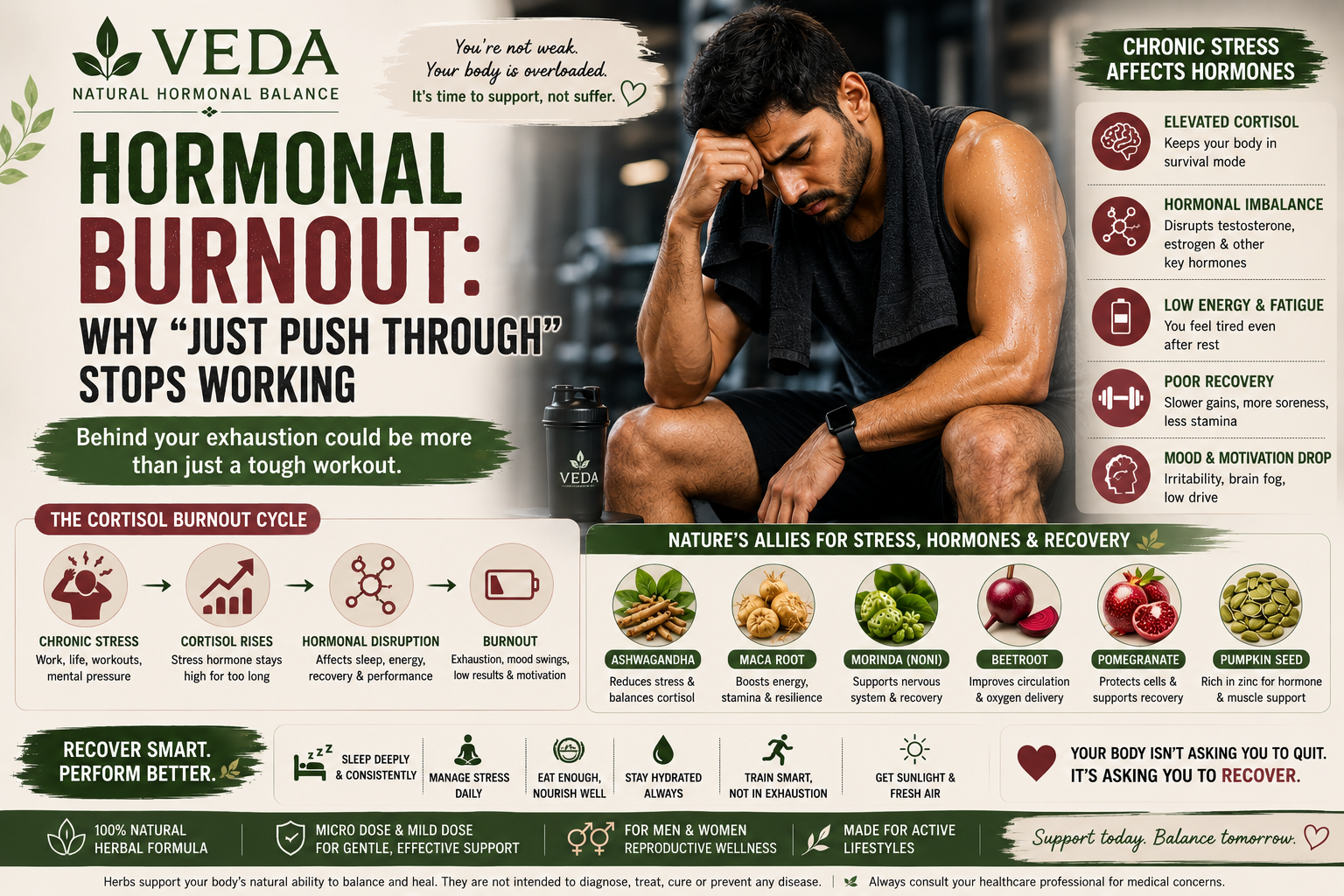
When “Pushing Through” Stops Working
You’ve always been able to handle pressure.
Work. Responsibilities. Life.
You just pushed through.
But lately… something changed.
You feel constantly exhausted.
Your motivation disappeared.
Your sleep is never refreshing.
Your body feels heavy, slow, and emotionally drained.
And the old strategy — “just push through” — isn’t working anymore.
This isn’t laziness. This isn’t weakness.
This is hormonal burnout.
What Is Hormonal Burnout?
Burnout isn’t just mental tiredness.
It has a biological root.
Here’s the simple chain:
Chronic Stress → Cortisol Overload → Hormonal Imbalance → Burnout
- Ongoing pressure keeps stress hormones (cortisol) elevated
- High cortisol disrupts thyroid, sex hormones, and neurotransmitters
- Your body shifts from “energy production” to “survival mode”
- You experience deep fatigue, brain fog, mood swings, and low resilience
This is the reality of burnout and hormones — they are deeply connected.
Signs of Hormonal Burnout You Might Be Ignoring
Chronic stress fatigue doesn’t look dramatic at first. It looks like:
- Waking up tired even after 8 hours of sleep
- Feeling drained by midday
- Low motivation for things you used to enjoy
- Irritability or emotional sensitivity
- Brain fog and poor concentration
- Reduced libido (in both men and women)
- Irregular cycles or low testosterone symptoms
- Feeling “wired but tired” — restless yet exhausted
These are classic cortisol burnout symptoms. Your body is stuck in high alert with no recovery.
Why “Just Push Through” Makes It Worse
For years, we’ve been taught to ignore fatigue and override stress.
But when you push through hormonal burnout:
- Cortisol stays high → deeper hormone disruption
- Sleep quality plummets → less repair
- Motivation circuits burn out → apathy increases
- Physical performance drops → injury risk rises
Your body isn’t being lazy. It’s protecting itself.
And pushing harder only prolongs the imbalance.
The Cortisol-Burnout Loop
Cortisol is your body’s main stress hormone. Short bursts are helpful. But when stress becomes chronic:
- Cortisol stays elevated day and night
- This suppresses DHEA, thyroid, and sex hormones
- Energy production (mitochondria) slows down
- Inflammation increases
You end up in a loop: stressed → poor sleep → more stress → exhaustion.
Breaking that loop requires support — not more willpower.
Understanding Natural Support (Recovery-Focused)
The goal is not to “boost energy” artificially. It’s to help your body exit survival mode.
🌿 Adaptogens for Cortisol Balance
- Ashwagandha → helps regulate cortisol and restore stress resilience
- Maca Root → supports adrenal adaptation and energy without overstimulation
- Morinda (Noni) → supports nervous system recovery and emotional balance
These are foundational for cortisol burnout recovery.
⚡ Mitochondrial & Energy Support
- Beetroot & Pomegranate → support circulation and cellular energy production
- Watermelon Extract → supports nitric oxide and tissue recovery
When mitochondria recover, energy returns naturally.
🧠 Mood & Nervous System Support
- Cocoa → supports mood and neurotransmitter balance
- Spearmint → supports hormonal clarity and calm
- Flaxseed → supports hormone signaling
Burnout affects both brain chemistry and hormones.
🍃 Nutritional & Cellular Nourishment
- Moringa → provides micronutrients depleted by chronic stress
- Ginger, Cinnamon, Black Pepper → support digestion and absorption
Recovery requires usable nutrients.
Small Steps to Recover from Hormonal Burnout
You don’t need a complete life overhaul. Start with these:
- Prioritize sleep consistency — go to bed and wake at the same time
- Reduce caffeine and alcohol, which can keep cortisol high
- Take 10–15 minutes daily with no stimulation (no phone, no noise)
- Eat regular, balanced meals to stabilize blood sugar
- Move gently — walking, yoga, or light strength training
- Say “no” to unnecessary obligations while you recover
Small, consistent support is more powerful than heroic effort.
A Reassuring Truth About Burnout Recovery
Hormonal burnout is not permanent. Your body can restore balance — but it needs time and the right conditions.
You are not broken. You are not weak. You are simply running on empty after carrying too much for too long.
Preventive wellness is about listening before the crash. And if you’re already in burnout, it’s about supporting gently, not pushing harder.
A Thought to Carry Forward
The culture of “just push through” ignores biology. Your hormones don’t respond to motivational quotes — they respond to rest, nourishment, and safety.
When you stop fighting your body and start supporting it, recovery becomes possible.
Start supporting your body before it starts asking louder. And if it’s already loud — start anyway, gently.
FAQ Section
— Always consult a healthcare provider before starting new supplements, especially if you have underlying conditions.