
Why Does My Mind Feel So Slow Lately?
You walk into a room and forget why.
You reread the same sentence three times.
Simple tasks feel mentally heavier than before.
And focusing for long periods suddenly feels exhausting.
At first, you assume you’re just tired.
But over time, you begin wondering:
“Why does my brain feel foggy after stress?”
If this sounds familiar, you’re not imagining it.
And no—your mind is not “getting weak.”
When Stress Quietly Affects Your Thinking
Stress doesn’t only affect emotions.
It affects focus too.
Many people experiencing
brain fog after stress
notice:
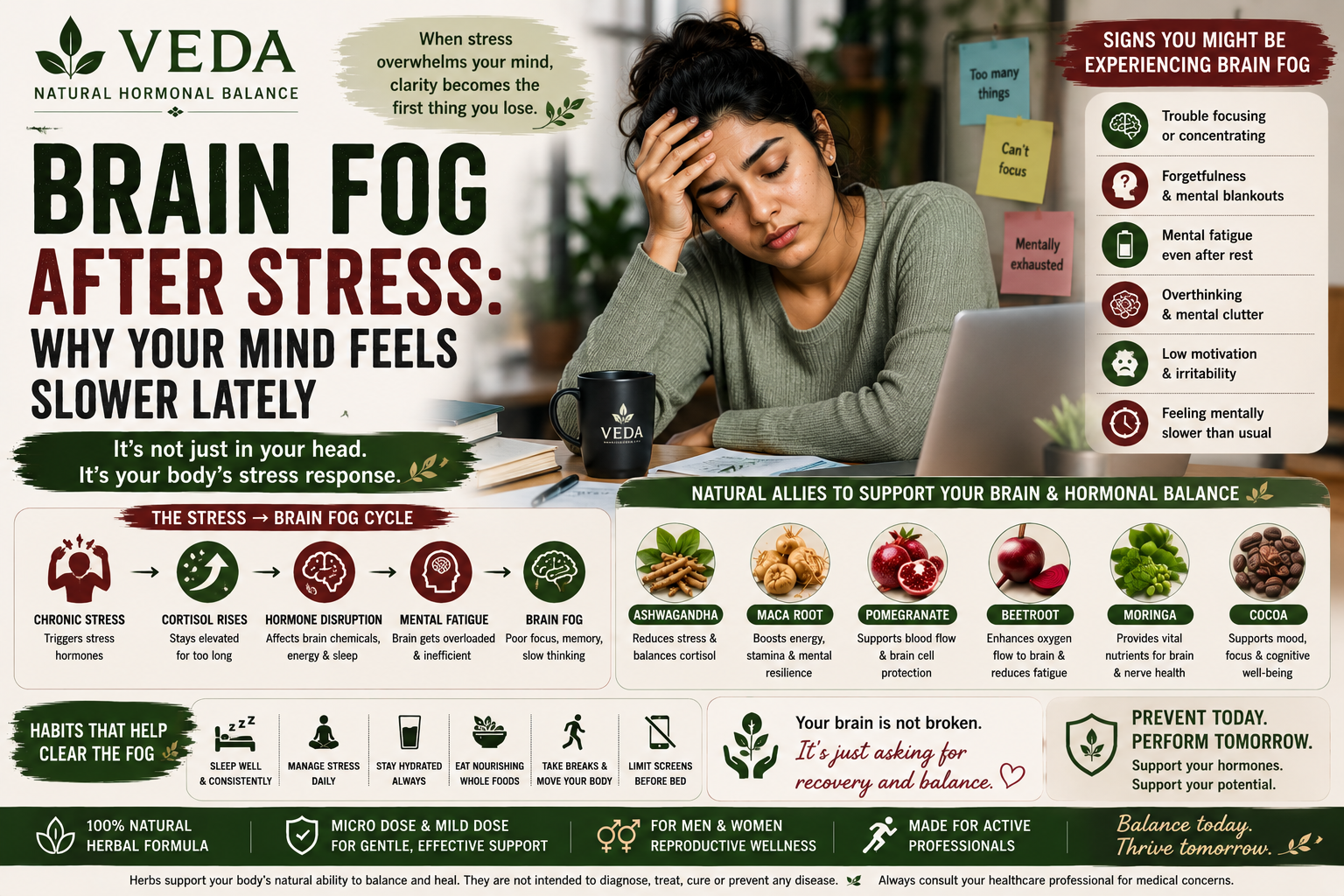
- Difficulty concentrating
- Forgetfulness
- Mental slowness
- Low motivation
- Feeling mentally overloaded
- Trouble making decisions
This is often connected to
mental fatigue.
And it becomes more noticeable after long periods of emotional pressure.
What’s Happening Inside Your Body (Simple Explanation)
Your brain needs recovery just like your body does.
Here’s the simple chain:
Chronic Stress → Elevated Cortisol → Poor Recovery → Brain Fog
- Stress increases cortisol levels
- Sleep and recovery quality decline
- Mental energy becomes depleted
- Focus and concentration begin slowing down
This creates what many people experience as
stress and concentration problems.
Stress-linked hormonal imbalance is strongly associated with mental fatigue, brain fog, emotional exhaustion, and reduced focus.
Why Hormones Affect Mental Clarity
Most people think hormones only affect mood or reproduction.
But hormones also influence:
- Mental sharpness
- Focus
- Emotional stability
- Energy production
- Sleep quality
When stress hormones stay elevated for too long, the brain struggles to recover properly.
This is why many people experience
hormonal brain fog.
Especially during periods of:
- Burnout
- Poor sleep
- Chronic stress
- Emotional overload
Signs Your Brain May Be Mentally Overloaded
You may relate to these:
- Feeling mentally tired all day
- Difficulty staying focused
- Forgetting small things easily
- Feeling emotionally drained
- Brain feeling “slow” or heavy
- Trouble processing information quickly
These are common stress-related recovery signals.
Not personal failures.
A Reassuring Truth You Need to Hear
Your brain is not broken.
It may simply be overstressed.
Modern life keeps many people in constant stimulation:
- Work pressure
- Overthinking
- Notifications and screens
- Emotional stress
- Poor recovery habits
Eventually, the nervous system slows mental processing as protection.
That’s not weakness.
That’s your body trying to conserve energy.
Understanding Natural Support (Focus + Stress Recovery)
The goal is not to “force productivity.”
It’s to support recovery and mental clarity naturally.
🌿 Stress & Nervous System Support
- Ashwagandha → supports stress hormone balance
- Morinda (Noni) → supports nervous system resilience
These herbs are commonly associated with stress adaptation and emotional recovery.
🧠 Mental Fatigue & Brain Support
- Pomegranate → supports antioxidant and cellular recovery
- Beetroot → supports circulation and oxygen delivery
Mental clarity depends on healthy circulation and recovery.
⚡ Energy & Motivation Support
- Maca Root → supports vitality, resilience, and mental stamina
- Honey Powder → gentle natural energy support
Because mental fatigue often affects motivation too.
🧬 Nutritional Support
- Moringa → provides vitamins and micronutrients
- Flaxseed → supports healthy hormone signaling
- Cocoa → supports emotional well-being and antioxidant balance
A nourished brain functions better.
🔥 Digestion & Absorption Support
- Ginger & Black Pepper → support nutrient absorption and circulation
Recovery starts with how well the body uses nourishment.
Small Habits That Improve Mental Clarity
You don’t need extreme “brain hacks.”
Simple recovery habits help more than people realize:
- Sleep consistently
- Reduce overstimulation at night
- Take breaks without screens
- Get sunlight daily
- Stay hydrated
- Avoid multitasking constantly
Mental recovery requires calm too.
A Perspective Worth Remembering
Brain fog is often a stress signal—not a sign that you’re incapable.
Your nervous system may simply be overloaded and under-recovered.
Preventive wellness is about supporting mental and hormonal balance before deeper exhaustion develops—not waiting until burnout becomes overwhelming.
A Thought to Carry Forward
Your mind is not meant to function under nonstop pressure forever.
And sometimes…
What feels like laziness is actually mental exhaustion asking for recovery.
You do not need to push harder every time your brain feels tired.
Sometimes the better answer is gentler support, slower recovery, and more balance.
Support your body and mind before stress grows louder.
FAQ Section
— Always consult a healthcare provider before starting new supplements, especially if you have underlying conditions.